Sneaky Scientific Method: Circuit Circus


Students are constantly working through the steps of the scientific method when
they engage in problem solving activities, they just don't realize it!

If you ask students to turn on a flashlight and it doesn't light up they will immediately make make an observation (like the flashlight not working), and ask themselves a question (why isn’t it working). They come up with a likely reason, or hypothesis, (the batteries) and go to test their thinking (switching the batteries). They get some results (the flashlight still doesn’t work) and they are able to make a conclusion (the batteries weren’t the problem). Without realizing it, students have just walked through the entire scientific method. It’s a relatable demonstration you can use in the classroom to illustrate the process before you even cover the vocabulary.
In this activity we take this idea and turn it into a STEM challenge: give students wires, batteries (in battery holders) and light bulbs (in light bulb holders) and ask them to light up the lightbulb with no other instructions given!
They are expected to struggle!!
Once they tackle a simple circuit, you can add additional challenges like switches, buzzers, more lights, or an insulator/conductor test.
After the activity is complete, a class discussion can reveal the steps of the scientific method and students should come to realize that they completed all those steps during the challenge!
Here is a little more background info on circuits and electricity:

Electricity is the flow of electrons through a circuit. The word circuit sounds like the word circle which is a good hint to students. A circuit needs to be a closed system in order for the electrons to move. A circuit needs wires that conduct electricity, an item that uses the electrons (e.g. a light bulb or buzzer or motor) and a power source (e.g. a battery). A battery works by creating a difference in electrical charge between its two ends, called terminals, using chemical reactions inside it. Electrons are pushed from one terminal to the other through a circuit, and that flow of electrons is what powers devices.
To test if materials conduct electricity, you can set up a simple circuit with an extra wire and test different materials to see if the light bulb lights up. Some materials allow electrons to flow through them. These types of materials are called conductors. Materials that have loosely bound electrons in the outermost layer (shell) make better conductors because these electrons can travel from atom to atom through the material. This movement is what causes the electrical current to be able to flow. Other materials called insulators don’t allow electrons to flow. Conductors will create a closed circuit and the light will turn on. Insulators will oppose the flow of electrons, creating an open circuit and the light will not turn on.
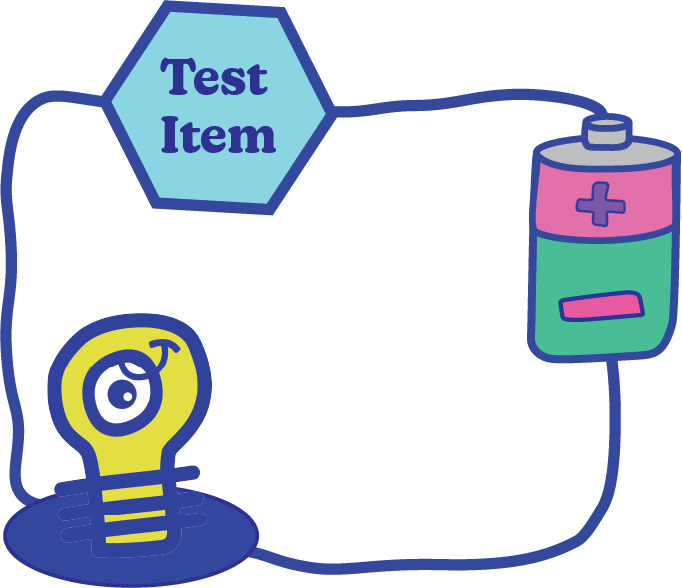
This is a great activity because you can test just about anything as long as you have a mix of metals and non metals. Typically, metals (aluminum foil, metal fork, the wire in a pipe cleaner, a paperclip) will conduct electricity and non metal items (plastic fork, cardboard, paper, fabric etc) will not conduct electricity.
Even though these concepts might seem too high level for lower grades, we find that they respond well to the tactile challenge! There is a lot to trouble shoot when setting up a circuit. Are the wires attached securely? Is the battery dead? Is the light bulb dead? How would we figure that out? When students get the light bulb to illuminate they beam (pun intended) with pride!!


Comments